Light Hygiene for Better Sleep (Especially for Women)
TL;DR: Your body clock runs on light—specifically, light hitting your eyes. The formula is simple: bright outdoor light soon after waking sets your internal clock forward, while dim, warm lighting for 2–3 hours before bed protects melatonin. If you’re stuck with screens or bright LEDs at night, stack your defenses: dim the room + use screen warmers (f.lux/Night Shift) + wear amber or red blue-blocking glasses. Window daylight helps your rhythm, but vitamin D requires outdoor exposure because standard glass blocks UVB. Your gut microbiome keeps time, too—better light habits support digestion and metabolism.
Why Light Is the Boss of Your Sleep
Deep in your brain sits the suprachiasmatic nucleus (SCN)—your master biological clock. The SCN takes its marching orders primarily from specialized cells in your eyes (intrinsically photosensitive retinal ganglion cells, or ipRGCs) that detect light, especially in the blue-to-cyan range. Morning light advances your clock (making you sleepy earlier that night), while evening light delays it and actively suppresses melatonin. This timing cascade shapes sleep quality, mood, body temperature, and hormone rhythms that are especially important for women’s health.
Takeaway: light isn’t just nice to have—it’s your most powerful free sleep tool.
Morning: Reset Your Clock in 5–15 Minutes
The golden window: within 30–60 minutes of waking. Your goal is simple: flood your eyes with bright light to signal “daytime” to your SCN.
- Go outside for 5–15 minutes (cloud cover weakens intensity, so linger longer on gray days).
- Can’t get outside? Sit by your brightest window—it’s still helpful, though indoor light is typically a few hundred lux compared with 10,000+ lux outdoors.
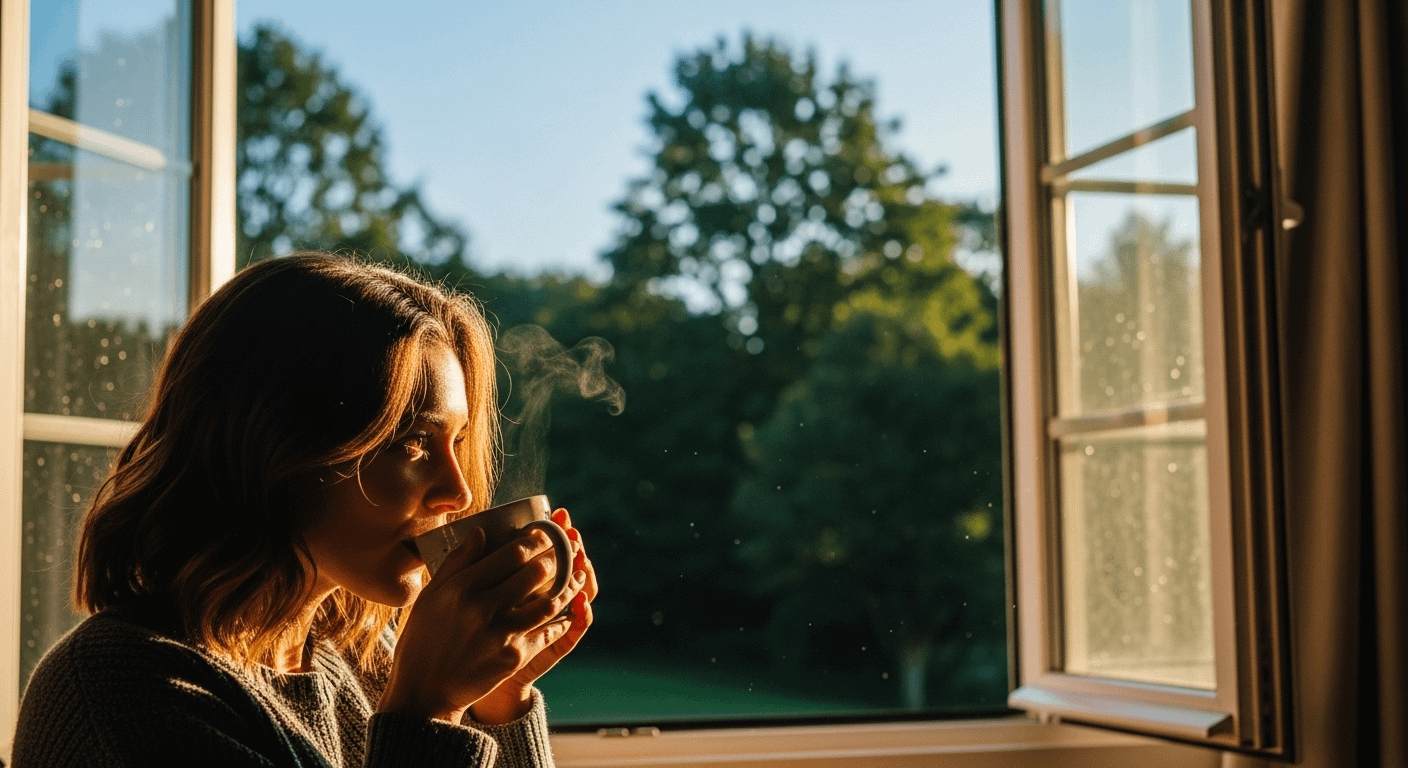
Pro tip: Combine light with movement. A short walk amplifies alertness and supports your natural cortisol rise. Even standing outside with your morning coffee counts.
Why it matters: This morning light anchor helps you feel naturally sleepy about 14–16 hours later. Skip it consistently and your clock drifts, making it harder to fall asleep at night.
Evening: The Melatonin Protection Protocol
In the 2–3 hours before bed, create an environment that whispers “nighttime” to your biology—dim, warm, and low-glare.
- Kill the overheads. After dinner, use lamps at or below eye level.
- Create a “night circuit.” Designate 2–3 warm-toned lamps in your most-used evening spaces; after dinner, those are your only light sources.
- Choose warm bulbs strategically. Cool-white LEDs deliver higher melanopic loads (more melatonin suppression) than incandescent/warm LEDs.
- Tame your screens. Enable f.lux or Night Shift and drop brightness—color shift alone isn’t enough at full blast.
The Great Bulb Debate: LEDs, Edison Bulbs, and OLEDs
Cool-white LEDs: energy-efficient but blue-enriched—less sleep-friendly at night.
Incandescent/Edison-style bulbs: naturally warm with minimal blue; gentler for evenings.
OLED lighting: typically emits less short-wavelength blue than standard LEDs and can be less melatonin-suppressive in lab settings. Still keep any evening light dim.
Practical approach: You don’t need to replace every bulb. Focus on the lights you use after dinner—two or three warm lamps can transform your evenings.
Window Light vs. Outdoor Light: What Actually Changes
For circadian rhythm: your central clock is set by light to the eyes in the visible spectrum—UV isn’t required. Daylight through a window still helps, but outdoor light is stronger and works faster.
For vitamin D: standard window glass blocks nearly all UVB, so you won’t make meaningful vitamin D behind closed glass. Aim for brief, sensible outdoor exposure appropriate for your skin type and season, or discuss diet/supplement options with your clinician.
The Power Stack: f.lux + Blue-Blocking Glasses
Software like f.lux/Night Shift shifts your screen toward warmer tones and reduces melanopic stimulus—especially when you also lower brightness. Color shift at full brightness is still problematic.
Amber/red blue-blocking glasses worn for about 2 hours before bed improved sleep vs. clear lenses in randomized trials, catching residual blue from lamps and other devices that software can’t remove.
- Priority order: 1) Dim & warm room lighting → 2) Screen warmer + low brightness → 3) Amber/red glasses.
Your Gut Microbiome Also Runs on a Clock
Your gut microbes follow daily rhythms largely choreographed by your body’s clocks. Disrupted light or irregular meals shift microbial outputs, affecting digestion, glucose handling, inflammation, and even mood-related neurotransmitters.
- Keep meals on a relatively consistent schedule.
- Finish dinner 2–3 hours before bed to support digestion and melatonin.
- Protect the light–dark cycle; circadian health is whole-body health.
The One-Week “Light Reset” Challenge
Every morning:
- Get 7–15 minutes of outdoor light within 60 minutes of waking.
- Bonus: add light movement (walk or simple stretches outside).
During the day:
- Sit near a window when working, if possible.
- Keep daytime environments bright—contrast makes evening dimming more effective.
After dinner (2–3 hours before bed):
- Switch to your warm night circuit (lamps only).
- Enable f.lux/Night Shift on all screens.
- Lower screen brightness until text is comfortable but not glaring.
- Wear amber/red glasses if lights or screens are on.
In your bedroom:
- Make it dark (blackout curtains or a quality sleep mask).
- Keep it cool (about 65–68 °F / 18–20 °C for most people).
Meal timing:
- Eat at consistent times day to day.
- Finish dinner 2–3 hours before bed.
Track your results:
- Sleep onset time (how long it takes to fall asleep).
- Wake time and how rested you feel.
- Energy levels at 10 a.m. and 3 p.m.
Most people notice steadier energy and easier sleep onset within 5–7 days.
Common Mistakes (and Quick Fixes)
Mistake #1: Blazing kitchen lights late at night.
Fix: Keep one warm counter lamp on; turn off ceiling lights after dinner.
Mistake #2: Night Shift on, but screen at full brightness.
Fix: Drop brightness until the screen is comfortable but clearly dimmer.
Mistake #3: Assuming window sun provides vitamin D.
Fix: It doesn’t through closed glass—step outside for brief, sensible exposure, or discuss testing/supplementation with your clinician.
Mistake #4: Wearing blue-blockers in a bright room.
Fix: Dim the environment first; glasses are the final layer.
Mistake #5: Weekend schedule drift.
Fix: Keep sleep and meal times within ~1 hour of weekdays.
App Spotlight: Circadian — Your Natural Rhythm
Circadian uses local solar events—dawn, sunrise, solar noon, sunset, and darkness—plus your inputs to suggest optimal windows for sleep/wake, meals/fasting, and exercise. It includes seasonal bedtime calculators, smart reminders, and education on syncing lifestyle with the natural light–dark cycle.
Get Circadian (iOS)
Get Circadian (Android)
Quick FAQ
Do I need sunlight on my skin to set my clock? No—your central clock is set by light to the eyes. Skin exposure matters for vitamin D and other local effects.
Is OLED better than LED at night? Often less blue and can be less melatonin-suppressive; intensity still matters, so keep it dim.
Are blue-blocking glasses enough? Helpful, but not sufficient in a bright room—dim the environment first.
What if I work night shifts? Use bright light during your work period and full darkness for daytime sleep (blackout solutions + consistent schedule).
Does red light at night disrupt sleep? It has minimal effect on melatonin and is a good choice for late-night needs.
References & Further Reading
- Circadian basics & SCN/ipRGCs:
NCBI Bookshelf: Physiology, Circadian Rhythm
•
CDC/NIOSH: Light & Circadian Timing - Evening home lighting & melatonin:
SLEEP (2024): Evening Light, Melatonin & Sleep
•
Review: LED spectra & circadian effects (Open Access) - OLED vs. LED effects at night:
Spectral impacts & melatonin/circadian review - Night Shift/f.lux effectiveness:
Harvard Health: Blue Light & Sleep
•
Sleep Foundation: Blue Light Basics - Blue-blocking glasses (clinical evidence):
Meta-analysis / clinical studies (PubMed)
•
Mechanisms: Light at Night & Melatonin (Open Access) - Glass & UVB transmission (vitamin D):
Health Physics Society: Do windows block UV?
•
NYTimes explainer: Vitamin D through glass - Gut microbiome circadian rhythms:
Host clocks shape microbial rhythms (Open Access)
•
Nature Communications (2022): Intestinal clocks & microbes - CDC circadian resources:
Light, alertness & circadian training module - App information:
Circadian — Your Natural Rhythm (iOS)
•
Android
Notes: Links open in a new tab. Educational content only and not a substitute for professional medical advice.