
How to Beat Jet Lag: The Complete Reset Protocol
Exercise is most effective when combined with other interventions. Consequently, here’s a comprehensive toolkit that you can implement today.
1) Get Morning Sunlight Immediately
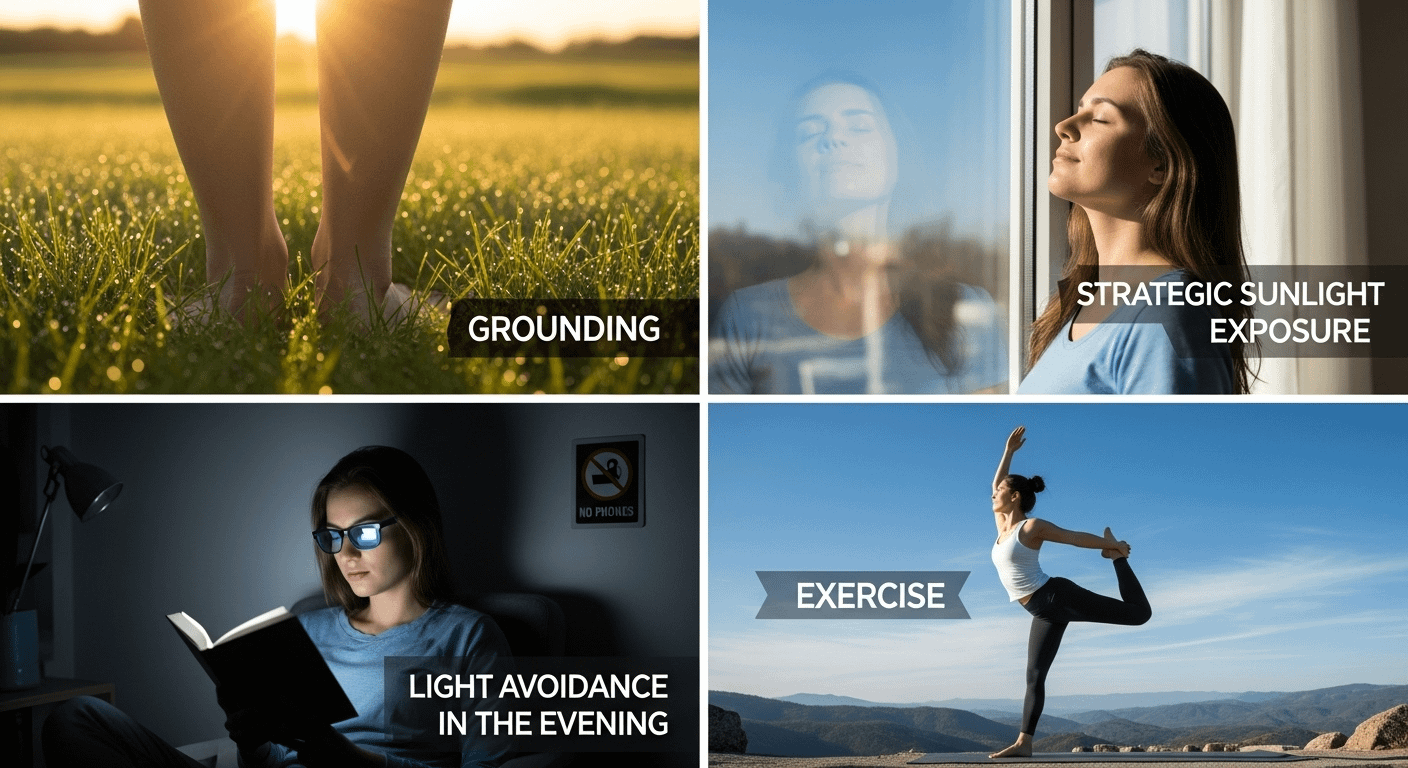
First, expose your eyes to bright outdoor light (no sunglasses if safe and comfortable). Moreover, seek light at sunrise, solar noon, and sunset—each cue strengthens your rhythm. For evidence, see Sleep Foundation on jet lag and Harvard Health jet lag tips.
2) Try Grounding (Earthing)
Additionally, walk barefoot on grass/sand/soil or use a grounding mat at night. Early studies suggest improvements to cortisol patterns and sleep; however, more rigorous trials are needed. Therefore, use grounding alongside light, sleep, and exercise.
3) Avoid Bright Light at Night
Meanwhile, evening light—especially unfiltered LEDs/screens—suppresses melatonin, delays your clock, and worsens sleep. Thus, use dim, warm lighting and screen filters after sunset. Learn more about how room light suppresses melatonin.
4) Supplement Melatonin Strategically
For short trips, consider 0.5–3 mg at local bedtime for 2–4 nights. Notably, many travelers do well with lower doses. Nevertheless, check medication interactions and conditions. See this melatonin & jet lag review.
5) Eat on Local Time
Likewise, metabolic clocks respond to meal timing. Therefore, start breakfast, lunch, and dinner on the destination schedule; in some cases, short fasts may help.
6) Use Power Naps Wisely
On arrival day, limit naps to 15–30 minutes; otherwise, long naps can fragment night sleep and, consequently, prolong adjustment.
7) Consider Red Light Therapy
Furthermore, gentle red-light exposures may support relaxation and recovery. Even so, avoid bright blue/white light in the evening.
8) Exercise Strategically to Accelerate Adjustment
- Why it helps: exercise is a powerful time cue (zeitgeber) for peripheral clocks; consequently, it improves mood, alertness, and recovery.
- Timing: for eastward trips, train morning/early day; for westward, however, avoid intense late-evening sessions.
- Best types: outdoor walks/jogs, cycling, swimming, or bodyweight—because movement plus daylight is a potent combo.
Sample Day Schedules to Beat Jet Lag (Back Home After a ±12-Hour Shift)
Goal: lock your body to local time with morning light, low evening light, smart exercise, and meal timing. Additionally, melatonin (0.5–3 mg) at local bedtime for 2–4 nights is optional.
If You Land in the Morning (local time)
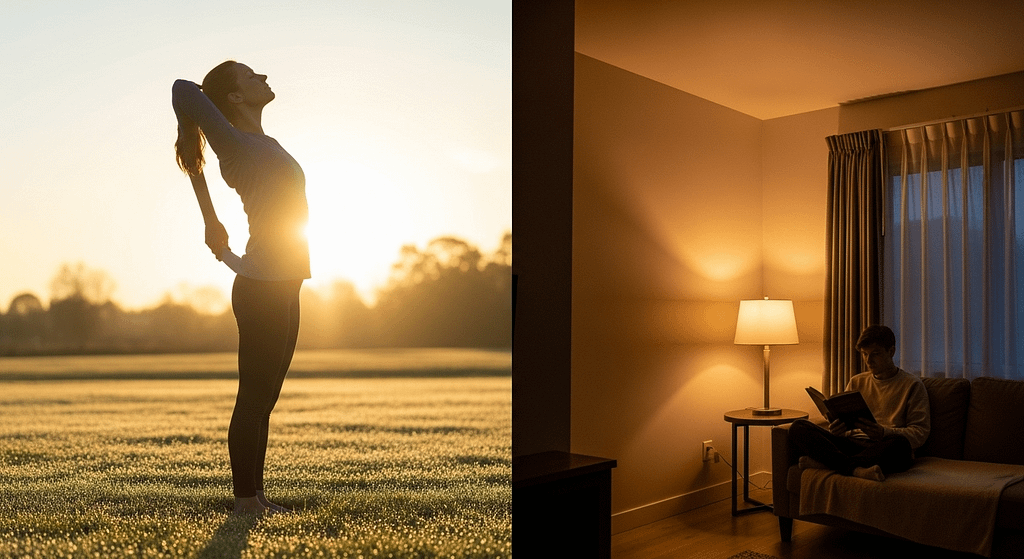
- First: get 20–30 min outdoor light + a walk; hydrate; choose a high-protein breakfast.
- Next: do light movement/errands; avoid long naps.
- Then: eat lunch on local time.
- Afterward: take an optional 15–20 min power nap.
- Later: get outdoor light + an easy workout.
- Finally: keep evening light dim; filter screens; consider melatonin 30–60 min pre-bed.
If You Land in the Evening (local time)
- First: keep lights dim; have a small snack; aim for local bedtime.
- Then: on Day 1 morning, get outdoor light immediately and add an easy walk.
- Next: schedule a moderate workout late morning or early afternoon; meanwhile, eat meals on local time.
- Finally: keep lights dim again in the evening and avoid intense late workouts.
3-Day Anchor Plan (Either Landing Scenario)
Overall, repeat the same anchors for three days so your clock stabilizes. Consequently, the adaptation holds even after travel stress fades.
| Local Time | Day 1 | Day 2 | Day 3 |
|---|---|---|---|
| Wake | Fixed window (±30 min); outdoor light 20–30 min | Similarly, keep the same | Likewise, keep the same |
| AM Movement | Easy → moderate | Then, moderate | Finally, moderate/hard if recovered |
| Meals | Breakfast, lunch, dinner on local time | Again, same | Again, same |
| Nap | ≤20 min before 15:30 (optional) | Otherwise, optional | Prefer to skip |
| Caffeine | Morning only; cut off ≥8 h pre-bed | Similarly, same | Similarly, same |
| Evening | Dim, warm light; screen filters | Then, same | Finally, same |
| Bedtime | Consistent; melatonin optional | Afterward, optional | Ultimately, usually not needed |
Mistakes to Avoid When You’re Learning How to Beat Jet Lag
- First, avoid bright screens after sunset and unfiltered LEDs at night.
- Second, skip long naps >30 min on Days 0–2.
- Third, stop caffeine within 8 hours of bedtime.
- Finally, avoid intense workouts late in the evening.
Safety: If you are pregnant/breastfeeding, have medical conditions, or are taking medications (e.g., anticoagulants, anti-seizure, immunosuppressants), consult your healthcare provider before taking melatonin. If insomnia or daytime impairment persists for more than two weeks, see a sleep specialist.
Further Reading
- Sleep Foundation — Jet Lag: Symptoms & Treatments
- Harvard Health — How to Avoid Jet Lag
- NIH/PMC — Melatonin & Jet Lag Review
- Nature Scientific Reports — Room Light Suppresses Melatonin
Jet Lag FAQ
How many days does jet lag last?
Typically, it lasts about a day per time zone crossed. However, smart light timing, short-term melatonin, and morning exercise can shorten recovery.
What melatonin dose is best?
In general, 0.5–3 mg at bedtime works for many adults when administered locally for 2–4 nights. Nevertheless, check medications and medical conditions first.
Morning workouts or evening?
Usually, morning or early-day training helps eastbound shifts. Conversely, vigorous late-evening sessions can delay your clock and disrupt sleep.
Do blue-blocking glasses help?
Yes—after sunset they reduce melatonin suppression from screens and LEDs. Even so, keep overall room lighting dim and warm-hued.